Monday, September 28, 2015

Gaga As Never Seen Before!

Wow! Lady Gaga honors 
The Sound of Music 
at the Oscar’s and it was really good 
The “Poker Face” singer has been branching out from her unorthodox brand lately, showing a different side to her vast musical talent. You may have recently heard the singer performing hit ballads with Tony Bennett. Well, last night at the Oscar’s she showed everyone another level, singing a compilation from The Sound of Music, and she nailed it! 


Julie Andrews Interview:
Lady Gaga's Oscars Tribute


In celebration of the 50th Anniversary Edition of "The Sound of Music," Dame Julie Andrews sits down with entertainment editor David Onda to talk about sharing the Oscars stage with Lady Gaga and her upcoming 80th birthday.

Aging, So What?


Monday, September 21, 2015

PLEASE EXPLAIN

I think this is in Thailand

Could someone please explain this to me?

Contact juggling street performance


How Men Peel Apples

This is AWESOME!!  I’ll bet my son would peel these for me with this method!  How about potatoes?!!
                   How men peel apples for a pie.


1910 Ford

1910 Ford
This has only been 105 years ago...Amazing!!!


Show this to your friends, children and/or grandchildren!
The year is 1910, over one hundred years ago.
What a difference a century makes!
Here are some statistics for the Year 1910:
(applies to the USA )

***********************************

The average life expectancy for men was 47 years.
Fuel for this car was sold in drug stores only.
Only 14 percent of the homes had a bathtub.
Only 8 percent of the homes had a telephone.
There were only 8,000 cars and only 144 miles of paved roads.
The maximum speed limit in most cities was 10 mph.
The tallest structure in the world was the Eiffel Tower !
The average US wage in 1910 was 22 cents per hour.
The average US worker made between $200 and $400 per year.
A competent accountant could expect to earn $2000 per year,
A dentist $2,500 per year, a veterinarian between $1,500 and $4,000 per year,
And a mechanical engineer about $5,000 per year.
More than 95 percent of all births took place at HOME.
Ninety percent of all Doctors had NO COLLEGE EDUCATION!
Instead, they attended so-called medical schools, many of which were
condemned in the press AND the government as 'substandard.'
Sugar cost four cents a pound.
Eggs were fourteen cents a dozen.
Coffee was fifteen cents a pound.
Most women only washed their hair once a month, and used Borax or egg yolks for shampoo.
There was no such thing as under arm deodorant or tooth paste.
Canada passed a law that prohibited poor people from entering into their country for any reason.

The five leading causes of death were:
1. Pneumonia and influenza
2, Tuberculosis
3. Diarrhea
4. Heart disease
5. Stroke

The American flag had 45 stars.
The population of Las Vegas Nevada was only 30!
Crossword puzzles, canned beer, and iced tea hadn't been invented yet
There was no Mother's Day or Father's Day.
Two out of every 10 adults couldn't read or write and only 6 percent of all
Americans had graduated from high school.
Eighteen percent of households had at least one full-time servant or domestic help.
There were about 230 reported murders in the ENTIRE U.S.A. !

(yes, people have changed)

I am now going to forward this to someone else without typing it myself.
From there, it will be sent to others all over the WORLD...all in a matter of seconds!

Try to imagine what it may be like in another 100 years


English Isn't As Easy As You Think. This Guy Nails It.

You think English is easy?

1) The bandage was wound around the wound.

2) The farm was used to produce produce.

3) The dump was so full that it had to refuse more refuse.

4) We must polish the Polish furniture..

5) He could lead if he would get the lead out.

6) The soldier decided to desert his dessert in the desert..

7) Since there is no time like the present, he thought it was time to present the present.

8) A bass was painted on the head of the bass drum.

9) When shot at, the dove dove into the bushes.

10) I did not object to the object.

11) The insurance was invalid for the invalid.

12) There was a row among the oarsmen about how to row.

13) They were too close to the door to close it.

14) The buck does funny things when the does are present.

15) A seamstress and a sewer fell down into a sewer line.

16) To help with planting, the farmer taught his sow to sow.

17) The wind was too strong to wind the sail.

18) Upon seeing the tear in the painting I shed a tear..

19) I had to subject the subject to a series of tests.

20) How can I intimate this to my most intimate friend?

Let's face it - English is a crazy language. There is no egg in eggplant, nor ham in hamburger; neither apple nor pine in pineapple. English muffins weren't invented in England or French fries in France . Sweetmeats are candies while sweetbreads, which aren't sweet, are meat. We take English for granted. But if we explore its paradoxes, we find that quicksand can work slowly, boxing rings are square and a guinea pig is neither from Guinea nor is it a pig.

And why is it that writers write but fingers don't fing, grocers don't groce and hammers don't ham? If the plural of tooth is teeth, why isn't the plural of booth, beeth? One goose, 2 geese. So one moose, 2 meese? One index, 2 indices? Doesn't it seem crazy that you can make amends but not one amend? If you have a bunch of odds and ends and get rid of all but one of them, what do you call it?

If teachers taught, why didn't preachers praught? If a vegetarian eats vegetables, what does a humanitarian eat? Sometimes I think all the English speakers should be committed to an asylum for the verbally insane. In what language do people recite at a play and play at a recital? Ship by truck and send cargo by ship? Have noses that run and feet that smell?

How can a slim chance and a fat chance be the same, while a wise man and a wise guy are opposites? You have to marvel at the unique lunacy of a language in which your house can burn up as it burns down, in which you fill in a form by filling it out and in which, an alarm goes off by going on.

English was invented by people, not computers, and it reflects the creativity of the human race, which, of course, is not a race at all. That is why, when the stars are out, they are visible, but when the lights are out, they are invisible.

Three Blondes

Three blondes were all applying for the last available position on the Toronto Police Force.

The detective conducting the interview looked at the three of them and said, "So you all want to be cops, huh?"

The blondes all nodded.

The detective got up, opened a file drawer, and pulled out a folder.

Sitting back down, he opened it, pulled out a picture, and said,

"To be a detective, you have to be able to detect. You must be able to notice things such as distinguishing features and oddities like scars and so forth."

So saying, he stuck the photo in the face of the first blonde and withdrew it after about two seconds.

"Now," he said, "did you notice any distinguishing features about this man?"

The blonde immediately said, "Yes, I did, he has only one eye!"

The detective shook his head and said,"Of course he has only one eye in this picture!
It's a profile of his face! You're dismissed!"

The first blonde hung her head and walked out of the office.

The detective then turned to the second blonde, stuck the photo in her face for two seconds,
pulled it back, and said, "What about you? Notice anything unusual or outstanding about this man?"

"Yes! He only has one ear!"

The detective put his head in his hands and exclaimed, "Didn't you hear what I just told the other lady?
This is a profile of the man's face! Of course you can only see one ear!
You're excused too!"

The second blonde sheepishly walked out of the office.

The detective turned his attention to the third and last blonde and said,
"This is probably a waste of time, but...."

He flashed the photo in her face for a couple of seconds and withdrew it, saying,
"All right, did you notice anything distinguishing or unusual about this man?"

The blonde said, "I sure did. This man wears contact lenses.

" The detective frowned, took another look at the picture, and began looking at some
of the papers in the folder.

He looked up at the blonde with a puzzled expression and said,
"You're absolutely right! His bio says he wears contacts! How in the world could you
tell that by looking at his picture?"

The blonde rolled her eyes and said,
"Well, Hellooooooooooooo!

With only one eye and one ear, ...he certainly can't wear glasses."

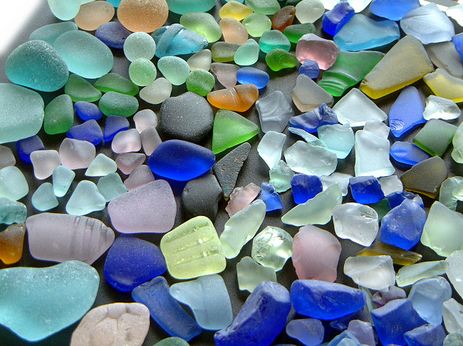
The Glass Beach

In the early 1900s, Fort Bragg, California, residents threw their household garbage over the cliffs above what is now Glass Beach.  
It is hard to imagine this happening today, But back then people dumped all kinds of refuse straight into the ocean, including old cars, and their household garbage, which of course included lots of glass.
Beginning in 1949, the area around Glass Beach became a public dump, and locals referred to it as The Dumps.
Sometimes fires were lit to reduce the size of the trash pile (up to 30 feet high).
However in 1967, the city leaders closed the area.
Various cleanup programs were undertaken through the years to try to correct the damage, but without success.

Over the next 30 years the pounding waves cleaned the beach, by breaking down everything but glass and pottery.
The pounding waves washed the trash up and down, back and forth.
Tons of polished, broken glass were created by the pounding surf.
These smoothened, colored glass particles then settled along the sea shore in millions, and so a magnificent beach was formed. The name was changed from, The Dump to what we currently know as, The Glass Beach.

The sea glass that was created is the product of a very long and interesting process.
It can take anywhere from 10 to 30 years to make sea glass, the name for any piece of glass that finds its way to the ocean and tumbles around in the water long enough to frost and smooth its surface.
Once it makes its way into the ocean, the glass is broken up into shards and is tumbled around in the water, where sand and other rocks act like sandpaper to smooth out its rough edges. Sometimes as the sea glass is passed through fire, it becomes fire glass, the rarest of sea glass with certain inclusions, just like precious gems.

In 1998, the private owner of the property determined that Glass Beach should belong to the public and in 2002 it became part of MacKerricher State Park, open to the public.
Within a period of a few years the Glass Beach won fame, attracting a large number of tourists every year.

Way back in time, people wanted to dump their glass products on this shore; now they would try to get one of these pieces to take home as a souvenir.
It is ironic but true that where once it was illegal to dispose the glass on the shore, it now is a crime to remove it. Visiting the Glass Beach today is a unique experience. What makes it even more remarkable, are the sounds produced by the glass pebbles as they are being washed away by the gentle waves.


 Glass, household appliances and even motor parts were discarded on the beach.

 The waves and weather conditions wore down the overwhelming amount of garbage in the water, creating millions of beautiful smooth rocks.


The beach’s moniker was soon changed from The Dump to The Glass Beach, a more attractive name for the now-beautiful beach.


The Glass Beach and the surrounded twenty acres were purchased by the California State Park system and were incorporated into MacKerricher State Park. 


 It’s hard to believe the short-sighted mistakes we were making that could have potentially ruined this beautiful spot.


But thanks to natural processes, the ocean transformed the trash into the sea glass.


 The ruby red glass stones are typically from old car tail-lights.


 Then, the sapphire rocks are the remnants of broken apothecary bottles.

 The beach at Fort Bragg isn’t the only glass beach in the world as strange and beautiful as it is.

 There are other places in the world where Mother Nature put a stop to our foolishness.


Historic Photos of WWII

CENSORED PHOTOS OF WW II

These photographs were classified during WW ll. 
Many of us have not seen photography like this before. 
Beautiful, stark black and white pictures, about 110 (much less listed here) of them, of historical significance in this collection. At the end of the pics there are some interesting comments. For many of us, our fathers and/or grandfathers participated in this action...World War II: The Pacific and Adjacent Theaters.

PLEASE SEE ORIGINAL WEB SITE HERE - 
WITH MANY MORE PICTURES IN A MUCH LARGER FORMAT AND MORE WEB SITES
 December 7, 1941: A small boat rescues a USS West Virginia crew member from the water after the Japanese bombing of Pearl Harbor, Hawaii. (AP Photo) Photo by Add this to feed
 December 7, 1941: Sailors stand among wrecked airplanes at Ford Island Naval Air Station as they watch the explosion of the USS Shaw in the background, during the Japanese surprise attack on Pearl Harbor, Hawaii. (AP Photo) Photo by Add this to feed
 December 7, 1941: The battleship USS Arizona belches smoke as it topples over into the sea during a Japanese surprise attack on Pearl Harbor, Hawaii. The ship sank with more than 80 percent of its 1,500-man crew. The attack, which left 2,343 Americans dead and 916 missing, broke the backbone of the U.S. Pacific Fleet and forced America out of a policy of isolationism. President Franklin D. Roosevelt announced that it was "a date which will live in infamy" and Congress declared war on Japan the morning after. (AP Photo)Photo by Add this to feed
  December 7, 1941: Eight miles from Pearl Harbor, shrapnel from a Japanese bomb riddled this car and killed three civilians in the attack. Two of the victims can be seen in the front seat. The Navy reported there was no nearby military objective. (AP Photo/U.S. Navy) Photo by Add this to feed
 December 7, 1941: Heavy damage is seen on the battleships U.S.S. Casin and the U.S.S. Downes, stationed at Pearl Harbor after the Japanese attack on the Hawaiian island. (AP Photo/U.S. Navy) Photo by Add this to fe
 Wreckage, identified by the U.S. Navy as a Japanese torpedo plane , was salvaged from the bottom of Pearl Harbor following the surorise attack Dec. 7, 1941. (AP Photo) Photo by Add this to feed
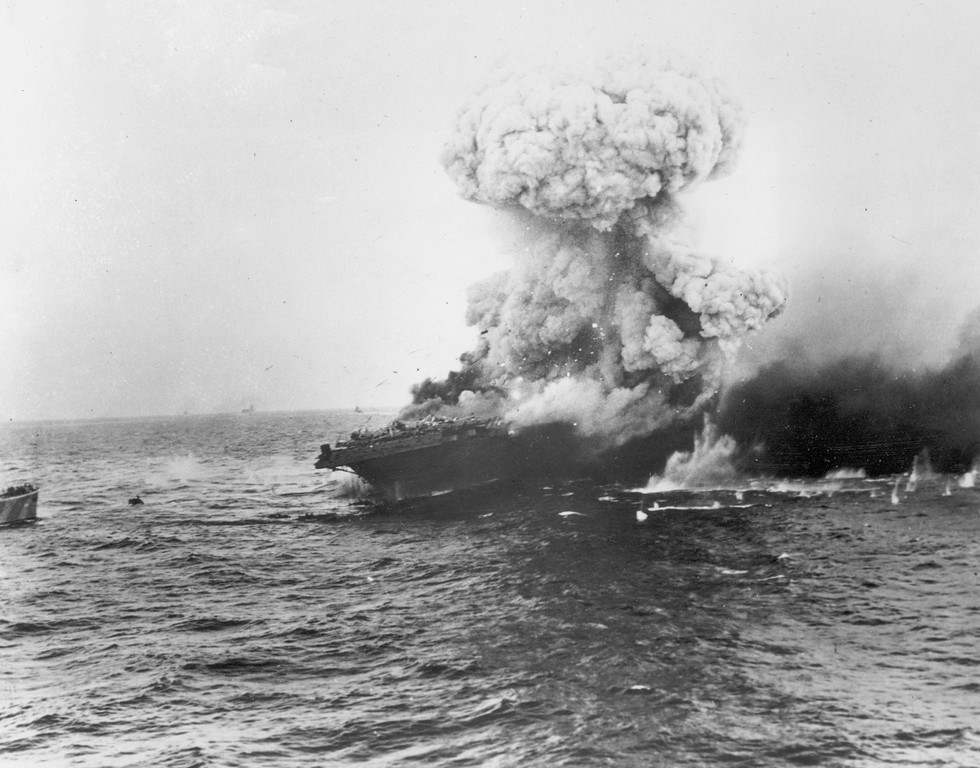
 June 1942: The USS Lexington, U.S. Navy aircraft carrier, explodes after being bombed by Japanese planes in the Battle of the Coral Sea in the South Pacific during World War II. (AP Photo) Photo by Add this to feed
 August 3, 1942: After hammering Port Moresby for two days, Japanese bombers finally sank this Australian transport which sends up a cloud of smoke. She drifted onto a reef and heeled over. Flaming oil can be seen at left. The men in a small boat, foreground, are looking for victims. (AP Photo) Photo by Add this to feed
  Aug. 1942: U.S. Marines approach the Japanese occupied Guadalcanal in the Solomon Islands during World War II. (AP Photo) Photo by Add this to feed
 Aug. 1942: U.S. Marines, with full battle kits, charge ashore on Guadalcanal Island from a landing barge during the early phase of the U.S. offensive in the Solomon Islands during World War II. (AP Photo) Photo by Add this to feed
 Nov. 3, 1942: Pushing through New Guinea jungles in a jeep, General Douglas MacArthur inspects the positions and movements of United Nations Forces, who would push the Japanese away from Port Moresby and back over the Owen Stanley Mountain range. (AP Photo) Photo by Add this to feed
 May 1942: After defending the island for nearly a month, American and Filipino soldiers surrender to Japanese invasion troops on Corregidor island, Philippines. This photograph was captured from the Japanese during Japan's three-year occupation. (AP Photo) Photo by Add this to feed
 January 1943: The bodies of three American soldiers, fallen in the battle for Buna and Gona, lie on the beach of the island in the Papua New Guinea region during World War II. (AP Photo) Photo by Add this to feed
 January 1943: While on a bombing run over Salamau, New Guinea, before its capture by Allied forces, photographer Sgt. John A. Boiteau aboard an army Liberator took this photograph of a B-24 Liberator during World War II. Bomb bursts can be seen below in lower left and a ship at upper right along the beach. (AP Photo/U.S. Army Force) Photo by Add this to feed
 Jan. 26, 1943: An infantryman is on guard on Grassy Knoll in Guadalcanal, Solomon Islands during World War II. (AP Photo) Photo by Add this to feed
 Jan. 21, 1943: Native stretcher bearers rest in the shade of a coconut grove as they and the wounded American soldiers they are carrying from the front lines at Buna, New Guinea take the opportunity to relax. The wounded are on their way to makeshift hospitals in the rear. (AP Photo) Photo by Add this to feed
 June 4, 1943: A wounded U.S. Marine is given a plasma transfusion by nurse Mae Olson aboard an aerial evacuation unit, over Guadalcanal, Solomon Islands. (AP Photo) Photo by Add 
 August 1943: Wounded American soldiers are seen as they lie aboard a lighter onshore at Munda Point, New Georgia island. (AP Photo) Photo by Add this to feed
 November 1943: A U.S. soldier wounded in the initial invasion at Empress Augusta Bay is being hoisted aboard a Coast Guard-manned transport off shore of Bougainville island. (AP Photo) Photo by Add this to feed
 Nov. 11, 1943: A supply ship, one of two that the Japanese were able to work through U.S. Air attacks, explodes in Rangoon Harbor (center) after a direct hit by a bomb from a Tenth U.S. Air Force Plane. Hits also were scored on port facilities, seen smoking (top center). Note numerous small craft moored at docks and offshore, (right). (AP Photo) Photo by Add this to feed
 Nov. 11, 1943: Crewmen of a U.S. Coast Guard combat transport go for a swim under the hull of a Japanese landmark in the Solomon Islands during World War II. The boat is the Kinugawa Maru, beached by the Japanese after being riddled by American gunners. Coast guardsmen took part in the original invasion of the Solomons. (AP Photo) Photo by Add this to feed
 December 26, 1943: U.S. Marines are seen from above as they wade through rough water to take the beach at Cape Gloucester on New Britain, Papua New Guinea. (AP Photo) Photo by Add this to feed
  
49January 1944: These U.S. Marine Raiders, with the reputation of being skillful jungle fighters, pose in front of a Japanese stronghold they conquered at Cape Totkina, 

 MArch 1944: Hundreds of pictures of pin-up girls adorn the entire wall of this bomber crew shack on Adak Island in the Aleutians in Alaska during World War II. (AP Photo)Photo by Add this to feed
 June 1944: A Japanese bomber is shot down as it attempted to attack the USS Kitkun Bay, near the Mariana Islands. (AP Photo) Photo by Add this to feed
July 1944: U.S. Marines walk away from a Japanese foxhole after blowing it up with explosives, during the invasion at Saipan, in the Mariana Islands. (AP Photo) Photo by Add this to feed
 March 10, 1945: U.S. troops in the Pacific islands continued to find enemy holdouts long after the main Japanese forces had either surrendered or disappeared. Guam was considered cleared by August 12, 1944, but parts of the island were still dangerous half a year later. Here, patrolling Marines pass a dead Japanese sniper. These Marines may belong to the Fifty-second Defense Battalion, one of two black units sent to the Pacific. (Charles P. Gorry, AP Staff/AP Archives) Photo by Add this to feed
 eptember 13, 1944: Japanese-occupied harbor of Cebu is under attack by U.S. Navy carrier-based fighter planes, at Cebu island, Philippines. (AP Photo) Photo by Add this to feed
  November 1944: A U.S. Marine flamethrowing tank attacks a Japanese pillbox, during the invasion of Saipan, in the Mariana Islands. (AP Photo) Photo by Add this to feed
 November 12, 1944: U.S. medics are seen as they treat wounded comrades at an portable surgical unit during the 36th Division's drive on Pinwe, Burma. (AP Photo) Photo by Add this to feed
 November 1944: U.S. landing ship tanks are seen from above as they pour military equipment onto the shores of Leyte island, to support invading forces in the Philippines. (AP Photo) Photo by Add this to feed
 Nov. 26, 1944: Burial at sea ceremonies are held aboard the USS Intrepid for members of the crew lost after the carrier was hit by a Japanese suicide pilot while operating off the coast of Luzon, the Philippines, during World War II. Sixteen men were killed in the kamikaze attack. (AP Photo/U.S. Navy) Photo by Add this to feed
 December 12, 1944: After being hit in a Japanese air raid, a B-29 Superfortress explodes in ball of fire, while crewmen of the U.S. air base try to fight the inferno on Saipan, Mariana Islands. (AP Photo) Photo by Add this to feed
 February 1945: The booted feet of a dead Japanese soldier, foreground, protrude from beneath a mound of earth on Iwo Jima during the American invasion of the Japanese Volcano Island stronghold in World War II. U.S. Marines can be seen nearby in foxholes. (AP Photo/Joe Rosenthal) Photo by Add this to feed
 Feb. 23, 1945: U.S. Marines of the 28th Regiment, 5th Division, raise the American flag atop Mt. Suribachi, Iwo Jima. Strategically located only 660 miles from Tokyo, the Pacific island became the site of one of the bloodiest, most famous battles of World War II against Japan. (AP Photo/Joe Rosenthal) Ph
 Feb. 28, 1945: Wounded when Jap fire made a direct hit on an Amtrac, a Marine is transferred by Coast Guardsmen to a landing craft off the flaming shore of Iwo Jima, Japan on D-Day. After darting in with boatloads of Marines, a Coast Guard-manned landing craft ran back to sea with casualties to LST's, specially fitted as temporary hospital ships. Intense enemy fire exacted a heavy toll as the beachhead was established on the island fortress only 750 miles from Tokyo. (AP Photo) Photo by Add this to feed
 March 16, 1945: A U.S. Marine approaches a Japanese soldier on Iwo Jima, Japan during World War II. The Japanese soldier was buried for 1 1/2 days in this shell hole playing dead and ready with a live grenade inches away from his hand. The Marines feared he might be further booby trapped underneath his body after knocking the grenade to the bottom of the shell hole. Promising no resistance, the prisoner is given a cigarette he asked for and was dragged free from the hole. (AP Photo) Photo by Add this to feed
 March 1945: Japanese night raiders are greeted with a lacework of antiaircraft fire by the U.S. Marine defenders of Yontan airfield, on Okinawa during World War II. In the foreground are Marine Corsair fighter planes of the "Hells Belles" squadron standing silhouetted against the sky. (AP Photo) Photo by Add this to feed
 March 19, 1945: The USS Santa Fe lies alongside the heavily listing USS Franklin to provide assistance after the aircraft carrier had been hit and set afire by a single Japanese dive bomber, during the Okinawa invasion off the coast of Honshu, Japan. (AP Photo) Photo by Add this to feed
 Aug. 9, 1945: A massive column of billowing smoke, thousands of feet high, mushrooms over the city of Nagasaki, Japan, after an atomic bomb was dropped by the United States. A B-29 plane delivered the blast killing approximately 70,000 people, with thousands dying later of radiation effects. The attack came three days after the U.S. dropped the world's first atomic bomb on the Japanese city of Hiroshima. The attacks brought about Japan's unconditional surrender. (AP Photo/U.S.Signal Corps) Photo by Add this to feed
Aug. 9, 1945: Terraced hillsides surrounding Nagasaki did little to lessen the destructiveness of the bomb dropped on this Japanese city. The city was almost completely destroyed except for a lone house standing here and there. (AP Photo) Photo by Add this to feed
 Sept. 3, 1945: This desolated area, with only some buildings standing here and there is what was left of Hiroshima, Japan after the first atomic bomb was dropped. (AP Photo)Photo by Add this to feed
 August 14, 1945: A sailor and a nurse kiss passionately in Manhattan's Times Square, as New York City celebrates the end of World War II. The celebration followed the official announcement that Japan had accepted the terms of Potsdam and surrendered. (AP Photo/Victor Jorgensen) Photo by Add this to feed
 August 14, 1945: A jubilant crowd of American Italians are seen as they wave flags and toss papers in the air while celebrating Japan's unconditional surrender in their neighborhood in New York City. (AP Photo) Photo by Add this to feed
September 2, 1945: Gen. Douglas MacArthur signs the Japanese surrender documents aboard the USS Missouri in Tokyo Bay. Lt. Gen. Jonathan Wainwright, left foreground, who surrendered Corregidor to the Japanese, and British Lt. Gen. A. E. Percival, next to Wainwright, who surrendered Singapore, observe the ceremony marking the end of World War II. (AP Photo) Photo by Add this to feed